

America Is Pricing Itself Out of the AI War
America cannot lead the AI era by restricting open weights and pricing capable intelligence beyond the reach of defenders, small businesses, and ordinary citizens.
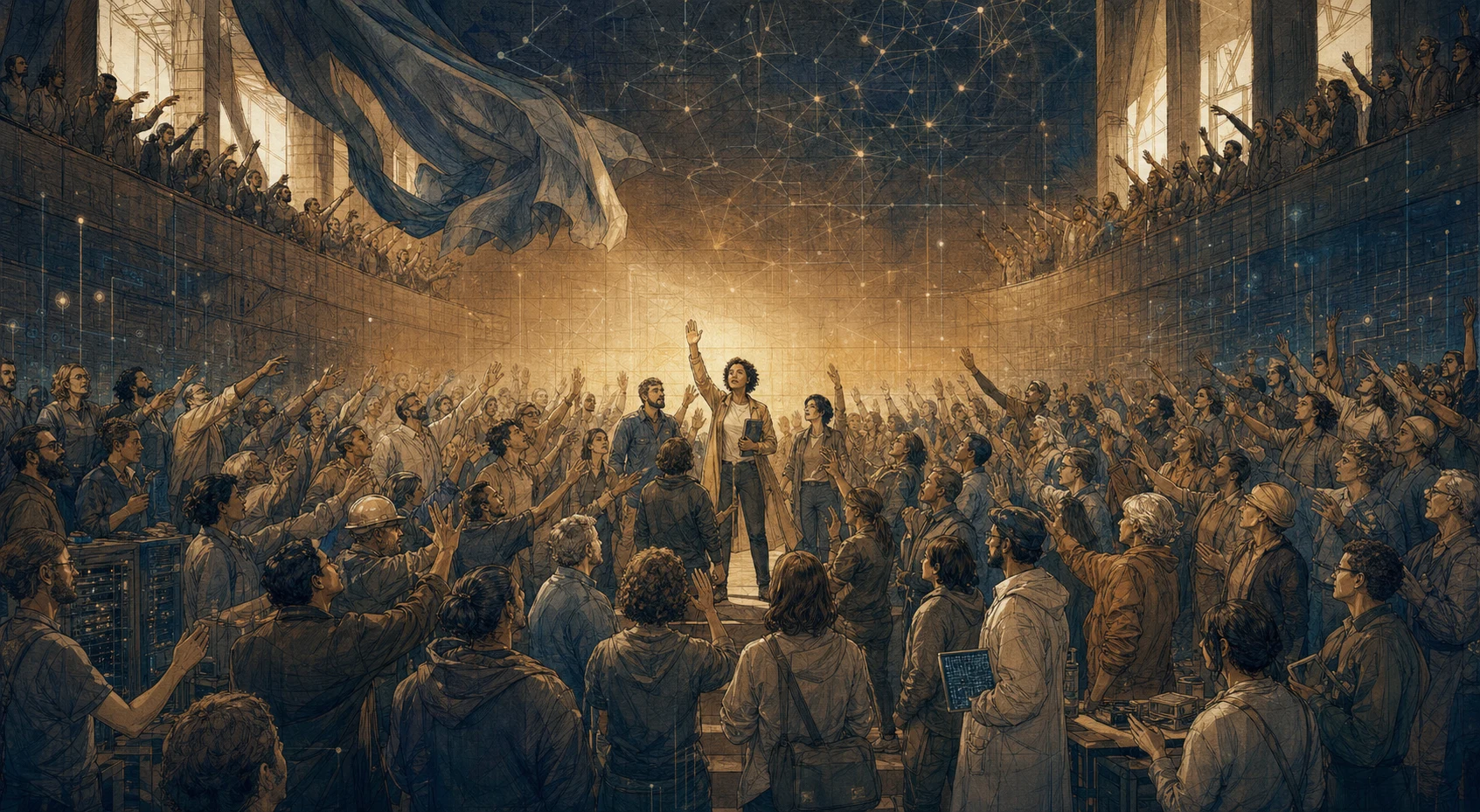
Open weights, cyber defense, and the price psychosis of American markets.
America is preparing to regulate itself into weakness.
Not because AI risk is imaginary. The risk is real.
The problem is that Washington keeps reaching for controls that bind Americans first and adversaries last.
In June, the Commerce Department ordered Anthropic to suspend foreign-national access to Fable 5 and Mythos 5. The restrictions were later lifted after new safeguards were implemented. Now, reporting indicates that parts of the administration are considering other ways to restrict access to leading Chinese open-weight models.
There is no blanket ban today.
The machinery for a de facto ban is being tested. (Reuters)
The asymmetry is the policy failure
American regulation is most enforceable against American companies, American researchers, American system administrators, and anyone operating inside American jurisdiction.
It cannot unpublish weights already circulating abroad.
It cannot prevent a foreign intelligence service, criminal group, or state-backed operator from adapting a model outside the United States.
It can prevent an American small business from using the same class of capability to defend itself.
That is the asymmetry.
Cyber defenders need affordable intelligence across endpoints, repositories, identity systems, cloud environments, network logs, and proprietary data. They need the ability to operate locally, privately, and sometimes completely offline.
Open weights provide that option.
They let defenders inspect the system, adapt it to their environment, and run it without sending sensitive code, logs, customer records, or intellectual property into a third-party API.
Commerce’s own NTIA recognized these benefits. Its open-model report found that widely available weights broaden participation, decentralize market control, and allow organizations to use AI without sharing data with third parties. It recommended monitoring risk, not restricting the open models then available. (NTIA)
Open weights are not a side issue.
They are defensive infrastructure.
The grand chessboard now includes model weights
In The Art of War in the Information Age, I wrote about US and Chinese competition as a grand chessboard of currency, information, cyber operations, supply chains, and industrial power.
Model weights are now another strategic asset on that board.
The winner may not be the country with the single best closed model.
The winner may be the country that makes capable intelligence cheap enough, portable enough, and open enough to become infrastructure everywhere.
China understands distribution as power.
America increasingly treats access as a product tier.
The price psychosis
This exposes a deeper American problem.
I call it price psychosis.
Price psychosis is what happens when high prices stop being treated as a constraint and start being treated as evidence of quality, safety, and progress.
GPT-5.6 Sol is priced at $30 per million output tokens. Claude Fable 5 and Mythos 5 are priced at $50 per million output tokens. That is before input tokens, long-context premiums, retries, tool calls, agent loops, infrastructure, and engineering. (OpenAI Developers)
A billion output tokens costs $30,000 to $50,000 at standard rates.
That may be tolerable for hyperscalers, federal agencies, major banks, and Fortune 500 companies.
It is not broad economic enablement for small businesses.
It is rented intelligence.
America’s biggest capitalist hurdle is not a lack of capital.
It is price-insensitive capital.
When price-insensitive purchasers shape a market, the market optimizes for them. Vendors build for government contracts, enterprise compliance, large procurement budgets, and recurring dependence.
Then the same product is marketed to the public as democratization.
A tool can be technically available and still be economically inaccessible.
That is not democratization.
That is dependency with better branding.
The structural blind spot
The mainstream narrative is detached from this economic reality.
Policymakers debate safety, sovereignty, and technological leadership while treating price and access as secondary concerns. There is almost no structural recognition of how the incentive system shapes the market.
The structure is never named, so each outcome is treated as an isolated crisis instead of the predictable result of the same incentives.
We measure AI progress through benchmarks, capital expenditure, model size, and corporate valuation.
We rarely ask whether a contractor, mechanic, independent retailer, farmer, local law firm, small manufacturer, or community hospital can afford to use the technology productively.
That is the real adoption test.
An economy organized around price-insensitive buyers will repeatedly produce expensive systems for incumbents, then call the result innovation for everyone.
This pattern is not limited to AI.
Freddie Mac estimated the US housing shortage at 3.7 million units using data through the third quarter of 2024. USDA now projects higher cattle prices in 2026 as tight supplies persist. The mechanics differ, but the incentive pattern is familiar: tolerate scarcity, protect incumbency, subsidize demand, normalize higher prices, and avoid structural reform. (Freddie Mac)
We have confused expensive markets with healthy markets.
We have confused restricted access with safety.
We have confused corporate concentration with national strength.
What American AI policy should protect
The answer is not zero controls.
Target malicious conduct. Control genuinely exceptional offensive capabilities. Apply restrictions to demonstrated risks, not entire categories of access. Create explicit safe harbors for defensive cybersecurity research.
A better standard can still become a plutocratic gate
Demis Hassabis has proposed a better starting point than blunt access controls. His framework would create a federally overseen, public-private standards body modeled partly on FINRA, with independent technical experts and open-source representatives on its board. It would define and continually update benchmarks for frontier-class models, test national-security capabilities with federal agencies and US National Labs, encourage model cards and internal cybersecurity, and eventually require frontier models to pass review before deployment in the US market. The framework would apply to frontier models whether open or closed and exempt non-frontier work from startups and academia. (Hassabis)
That is more coherent than banning access by nationality or treating all open weights as equally dangerous.
It focuses on demonstrated capability, not the mere fact that weights can be downloaded.
It also creates a better target for regulation: the small number of systems capable of producing exceptional harm.
But a technically better standard can still become an economically exclusionary standard.
Hassabis acknowledges that such a body would need substantial funding, likely from industry, plus world-class talent and the compute required for large-scale testing. The CIO account raises the corresponding governance problem: when the firms being regulated finance and help draft the rules, their operational reality can dominate the standard. (CIO)
The proposed exemption for non-frontier startups and academia matters.
It does not eliminate the structural risk.
Standards shape procurement, insurance, cloud access, investment, and public legitimacy long before a law formally bans anything. A “Frontier Lab” designation may become a badge that only the best-funded firms can obtain. A smaller lab that crosses the capability threshold could face a cliff of pre-release review, recurring evaluation, personnel vetting, internal cybersecurity, third-party audits, and safety staffing. An open-source collective may possess technical merit without possessing a hyperscaler’s compliance department.
If incumbents fund the institution, supply the compute, help define the benchmarks, and employ the experts most able to pass them, self-regulation can become a license to compete written by the companies that already won.
That would replace one form of concentration with another.
A serious American standards body must therefore be anti-plutocratic by design. Its benchmarks should be public; its held-out tests independently governed; its compute and evaluation resources available at subsidized rates; its obligations proportional to measured capability; and its safe harbors explicit for open-source development, defensive research, local deployment, and downstream adaptation. Small labs, universities, public-interest technologists, and open-source communities need voting power, not symbolic seats.
Otherwise, “self-regulation” becomes a paywall with federal force behind it.
Most importantly, build a serious American open-weight ecosystem.
Small businesses, researchers, local governments, system administrators, and ordinary citizens should be able to run capable AI under terms they can understand, prices they can afford, and infrastructure they can control.
The attacker needs one capable model.
The defender needs affordable capability across every network.
America cannot win the grand chessboard by pricing its own pieces off the board.
It cannot claim to democratize intelligence while concentrating ownership, access, and control into fewer hands.
The strategic objective should be simple: put capable intelligence into the hands of millions of Americans.
The everyday American needs to be empowered by AI, not enslaved by it.
References
- The Art of War in the Information Age, Y2
- The secret Trump administration battle to fight Chinese AI, Axios
- Anthropic disables top-tier models after US access order, Reuters
- US removes curbs on Anthropic’s Fable and Mythos models, Reuters
- Dual-Use Foundation Models with Widely Available Model Weights, NTIA
- OpenAI API pricing
- Claude Platform pricing
- Housing Supply: Still Undersupplied by Millions of Units, Freddie Mac
- Cattle and Beef Market Outlook, USDA Economic Research Service
- A Framework for Frontier AI and the Dawning of a New Age, Demis Hassabis
- DeepMind CEO pushes for AI industry self-regulation, CIO
- Regulatory action on chips, AI is coming, Commerce official says, Reuters
- Kimi K3’s performance bolsters Sacks’ case against AI regulation, Axios